Root Canal vs Dental Implant: Which One Should You Choose?
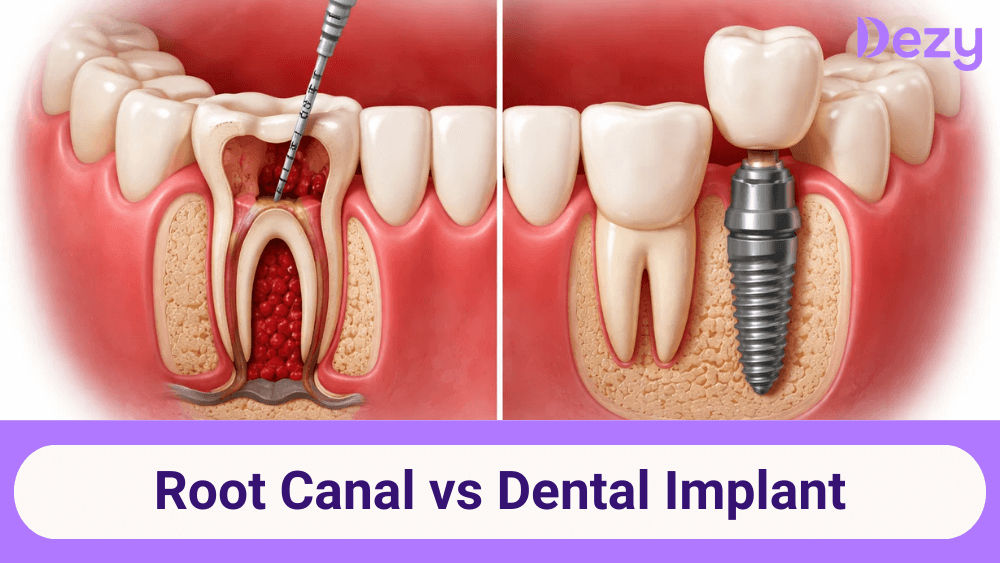
Both root canal and dental implants are clinically proven, safe, and widely used in India, but they solve very different dental problems. Choosing the wrong option can result in repeat treatments, higher costs, or long-term discomfort. This guide clearly explains the difference between root canal and implant, including cost, procedure, recovery, and long-term value, so you can make an informed decision with confidence.
Root Canal vs Implant: Root canals preserve the natural tooth, making them quicker and less invasive in India, usually completed in 1–2 visits at a cost of ₹3,000–₹10,000. Dental implants replace the tooth entirely and offer long-term durability but involve surgery, months of treatment, and higher costs of ₹25,000–₹60,000+. The right choice depends on how much of the natural tooth can be saved and the severity of the infection.
What Is a Root Canal?
A root canal is a dental procedure that is used to treat infection inside a tooth. The dentist removes infected pulp, cleans and disinfects the canals, and seals the tooth to prevent further infection, usually finishing with a crown for protection. This treatment helps preserve your natural tooth and prevents the need for extraction when the tooth structure can still be saved.
Why Is a Root Canal Needed?
A root canal is recommended when the tooth can still be saved, but the inner pulp is damaged or infected. Here are some scenarios in which this treatment can be a more sensible choice:
Deep tooth decay: If the tooth pulp is infected and causes pain that cannot heal on its own, this treatment can prove to be effective.
Cracked or fractured tooth: Cracks in teeth allow bacteria to enter the pulp, leading to inflammation or infection. Root canal can prove to be a great treatment choice.
Severe tooth pain or sensitivity: Persistent pain to hot, cold, or pressure often indicates pulp damage, which can be treated with a root canal.
Dental infection or abscess: Swelling, pus, or fever signals an advanced infection requiring immediate treatment.
Trauma to the tooth: Injury can damage the pulp even if the tooth looks intact externally.
Pros of a Root Canal
Preserves your natural tooth: A root canal allows you to keep your original tooth structure. This maintains the natural teeth alignment, preserving your biting and chewing capabilities.
Faster treatment timeline: Most root canal treatments are completed within one or two visits, making it a quicker solution compared to implants.
Lower upfront cost: Compared to dental implants, the upfront cost of a root canal treatment is generally more affordable, especially when the tooth can be saved without complications.
Minimal discomfort during treatment: With modern anaesthesia and techniques, root canal procedures are largely painless and well-tolerated.
Cons of a Root Canal
Not suitable for severely damaged teeth: If the tooth structure is too weak or extensively decayed, a root canal may not provide long-term stability.
Risk of future reinfection or fracture: Even after the treatment, there’s no guarantee that reinfection won’t occur. The tooth can weaken over time and may eventually require extraction.
Root Canal Step-by-Step Procedure: How Is a Root Canal Done?
Diagnosis & Pain Control: The dentist first takes an X-ray to assess infection or nerve damage and uses local anaesthesia to fully numb the tooth, ensuring the procedure is comfortable.
Removal of Infected Pulp: An opening is made in the tooth to remove the infected or dead nerve tissue, which helps reduce pain and prevent the infection from spreading further.
Cleaning & Sealing the Tooth: The inner canals are cleaned, disinfected, and sealed with a specialised filling material to protect the tooth from future infection.
Restoration: A dental crown is usually placed on top to restore strength and prevent the treated tooth from cracking during everyday chewing.
What Are Dental Implants?
Dental implants are a permanent tooth replacement option that involves placing a titanium screw into the jawbone to act as an artificial root. This is then followed by a crown that restores the tooth’s appearance and function.
Unlike other options, implants replace both the root and crown, making them the closest alternative to a natural tooth.
Why Is an Implant Needed?
A dental implant is advised when saving the natural tooth is no longer possible or practical.
Missing tooth: Implants replace lost teeth completely from root to crown.
Severely damaged tooth: When the tooth decay or fracture is beyond repair, far too extensive for a root canal, that’s when implants are considered.
Failed root canal treatment: If there’s a persistent infection or structural failure even after a root canal, dental implants may be required for extraction and replacement.
Bone loss after tooth extraction: Implants stimulate the jawbone and prevent further bone deterioration.
Long-term tooth replacement requirement: Implants offer a durable, one-time solution with minimal future maintenance.
Pros of Dental Implants
Replaces the tooth from root to crown: Dental implants restore both the missing root and crown, making them the closest alternative to a natural tooth.
Prevents jawbone loss: Implants stimulate the jawbone, helping maintain bone strength and facial structure over the long term.
Highly durable & long-lasting: With proper care, dental implants can last decades or even a lifetime.
Does not affect the neighbouring teeth: Unlike other treatments, implants stand independently and do not require support from adjacent teeth.
Cons of Dental Implants
Higher initial investment: The initial cost of getting dental implants is higher due to surgical placement, materials used, and treatment planning.
Longer treatment & healing time: The implant process involves surgery and bone healing, which can take several months before final tooth placement.
Minor surgical procedure required: Although safe, implant placement is still a surgical procedure and may not be suitable for everyone.
Dental Implants Step-by-Step Procedure: How Is an Implant Done?
Detailed Consultation & Planning: The dentist begins with the implant treatment by evaluating the bone quality using X-rays or 3D scans and then planning implant placement to ensure long-term stability and safety.
Surgery for Implant Placement: The next step of the treatment plan is implant placement. Here, a titanium implant is placed into the jawbone under local anaesthesia. This acts as an artificial tooth root.
Integration of Bone & Healing: Over the next 3 to 6 months, the implant fuses with the jawbone in a process called osseointegration.
Crown Attachment: Once the implant properly fuses with the jawbone and is healed, a connector (abutment) and a custom crown are fixed, restoring your ability to chew properly.
Root Canal vs Implant: Key Differences
The key difference between a root canal and a dental implant is tooth preservation versus replacement. A root canal saves your natural tooth by removing infection and sealing it, making it a quicker, less invasive, and more affordable option when the tooth can be preserved. A dental implant replaces a severely damaged or missing tooth with an artificial root and crown, offering long-term durability but involving surgery, higher cost, and a longer treatment timeline.
Root Canal vs Implant Cost in India
While a dental implant comes with a higher upfront cost in India, it also offers better durability and long-term oral health benefits.
Root Canal Cost in India - A root canal typically costs between ₹1,500 and ₹15,000 for a single tooth, excluding a dental crown. A dental crown may add another ₹5,000 to ₹25,000, depending on the material used. The factors influencing the costs of this treatment in India include the location of the tooth, the technique used, the dentist’s expertise, and the need for additional procedures.
Dental Implant Cost in India - A dental implant cost generally ranges from ₹20,000 to ₹90,000 or more per tooth. This usually includes surgery, abutment, and a crown.
Root Canal vs Implant: What Suits You Best?
Whether to go for a root canal or a dental implant depends on your overall dental health, bone density, budget, and long-term goals. Choose a root canal if your tooth can be saved, you want a faster solution, and cost is a concern. Choose an implant if the tooth cannot be saved, you want a permanent replacement, and long-term value matters more than upfront cost. A personalized consultation at Dezy ensures you choose the safest, most effective treatment for your smile!
Frequently Asked Questions (FAQs)
1. Is a root canal better than an implant?
A root canal is better when the tooth can be saved, while an implant is better when the tooth is missing or beyond repair.
2. Which is more painful: a root canal or an implant?
Root canals are generally less painful, while implants involve surgery and a longer healing period. The implant surgery itself is not painful, as it’s done under local anaesthesia, but the healing process may cause some discomfort.
3. How long does a root canal last in India?
With proper oral care and a crown, your root canal treatment can last about 10 to 15 years or more.