Dental Bridge vs Implant: Cost, Benefits, and Key Differences
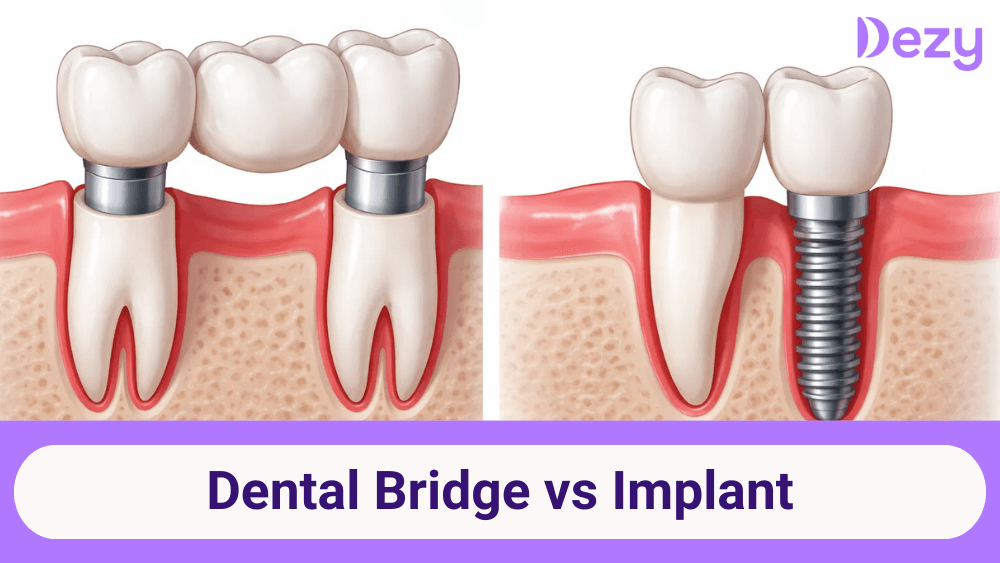
Both of these treatments are effective, widely used, and clinically proven. However, choosing between them is not always straightforward. Factors such as durability, cost, procedure complexity, and long-term oral health play a crucial role. This guide breaks down the difference between dental bridges and dental implants, helping you understand which option fits your needs best.
Dental Bridge vs Implant: Dental implants and bridges both replace missing teeth, but implants last longer, preserve jawbone health, don’t affect nearby teeth, and are easier to clean, often lasting 25-40+ years with proper care. Bridges are quicker, non-surgical, and cheaper upfront, but require grinding adjacent teeth, don’t prevent bone loss, and usually need replacement within 10-20 years.
Let’s take a closer look at each option in detail.
What Is a Dental Bridge?
A dental bridge is a fixed tooth replacement used to fill the gap left by one or more missing teeth. It works by anchoring an artificial tooth to the natural teeth on either side of the gap, helping restore basic chewing function and appearance.
It is often chosen for its shorter treatment time and lower upfront cost. However, the treatment relies heavily on surrounding teeth, which may need alteration even if they are healthy.
When to Consider a Dental Bridge
A dental bridge may be suitable if you are looking for a quicker or less invasive solution.
Your jawbone is not suitable for implants: When bone density is insufficient, and you want to avoid bone grafting or surgical augmentation, a bridge offers a practical non-surgical alternative.
You want a fixed solution without surgery: Dental bridges do not require implant surgery, making them suitable for patients who are medically unfit for surgery or uncomfortable with invasive procedures.
You need tooth replacement quickly: Bridges are ideal when time is a priority, as the entire treatment is usually completed within a few weeks instead of months.
Budget constraints matter more than longevity: If upfront affordability is a key concern and you are comfortable with future replacement, a dental bridge can be a cost-conscious solution.
Pros of Dental Bridges
Faster treatment process: Dental bridges can usually be completed within a few weeks, making them a quicker tooth replacement option.
Lower upfront cost: Compared to dental implants, dental bridges generally have a lower upfront cost.
Non-surgical approach: The procedure does not involve surgery, which may be preferable for patients seeking less invasive treatment.
Restores basic function and appearance: Dental bridges help improve chewing ability and smile aesthetics when teeth are missing.
Cons of Dental Bridges
Affects healthy neighbouring teeth: Supporting teeth need to be trimmed, even if they are healthy, which can weaken them over time.
Does not prevent bone loss: Because bridges sit above the gumline, they do not stimulate the jawbone, leading to gradual bone loss.
Limited lifespan: Most dental bridges need replacement after several years due to wear, decay, or gum changes.
Dental Bridge Procedure: Step by Step
Assessment & Tooth Preparation : The dentist first examines the tooth gap and prepares the neighbouring teeth by reshaping them to support the bridge.
Impressions & Measurements: The second step of this procedure consists of taking impressions. Dental impressions are taken to design a bridge that fits accurately and aligns well with your bite.
Temporary Bridge Placement: Then, a temporary bridge is placed to protect the prepared teeth while the permanent bridge is being made.
Final Bridge Fixation: The permanent bridge is cemented into place, restoring appearance and basic chewing function. The entire process usually takes 2 to 3 dental visits over a few weeks.
What Is a Dental Implant?
A dental implant is a permanent replacement for a missing tooth. It involves placing a small titanium screw into the jawbone, which acts like a natural tooth root, and fixing a crown on top to restore the look and function of the tooth.
Unlike bridges, implants do not depend on adjacent teeth. They also stimulate the jawbone, helping prevent bone loss over time.
When to Consider a Dental Implant
Dental implants are ideal for patients seeking durability and long-term oral health benefits.
You are replacing a long-time missing tooth: If a tooth has been missing for months or years, the jawbone may already be shrinking. Implants help stabilize the area and prevent further structural deterioration.
You want a solution that stands on its own: Dental implants do not depend on neighbouring teeth for support, making them ideal when surrounding teeth are healthy and should not be altered.
You want to avoid future replacements: If you prefer a one-time treatment and don’t mind the upfront cost, implants offer greater long-term predictability.
You are planning full-mouth or phased treatment: Implants work well when treatment is planned in stages, such as replacing multiple teeth over time or transitioning to full-mouth rehabilitation.
Pros of Dental Implants
Long-term solution: Dental implants are designed to last for decades and often a lifetime with proper oral hygiene and regular dental check-ups.
Preserves jawbone health: Implants stimulate the jawbone like natural tooth roots, helping prevent bone loss after tooth loss.
Does not affect adjacent teeth: Dental implants are placed independently and do not require grinding or supporting nearby healthy teeth.
Feels and functions like a natural tooth: Implants restore strong biting force and natural appearance, making everyday activities like chewing and speaking easier.
Cons of Dental Implants
Higher initial cost: Compared to dental bridges, dental implants usually come with a higher upfront cost due to the need for surgery, specific materials, and advanced planning.
Longer treatment duration: The process involves healing time for the implant to integrate with the bone, which can take several months.
Surgical procedure involved: Implant placement is a minor surgical procedure that may not suit patients with certain medical conditions.
Dental Implant Procedure: Step by Step
Detailed Evaluation & Planning: The dental implant process begins with an initial evaluation and planning of the treatment. The dentist assesses bone quality using X-rays or 3D scans to plan precise implant placement.
Implant Placement Surgery: A titanium implant is surgically placed into the jawbone under local anaesthesia in a controlled, sterile setting.
Healing & Bone Integration: The implant is left to heal and fuse with the jawbone through a process called osseointegration, which usually takes 3 to 6 months.
Abutment & Crown Placement: Once healed, an abutment and custom-made crown are attached, restoring full function and natural appearance.
Although the implant process takes longer, it provides a standalone, long-term tooth replacement option that closely mimics a natural tooth.
Key Differences Between Dental Bridges and Implants
The key difference between dental bridges and dental implants is support and longevity. Dental bridges replace missing teeth by anchoring an artificial tooth to adjacent natural teeth, offering a faster and less expensive solution but requiring alteration of healthy teeth. Dental implants replace the tooth root itself by integrating into the jawbone, providing better stability, preserving bone health, and lasting longer, though they involve surgery, higher cost, and a longer treatment process.
Cost of Dental Implant vs Dental Bridge in India
In India, dental implants generally come with a higher upfront cost than dental bridges, but they offer significantly better durability and long-term oral health benefits. While bridges are often chosen for their lower initial cost and faster treatment time, implants provide a permanent, root-level solution that closely mimics natural teeth.
Dental Implant Cost in India (Per Tooth) - The cost of a dental implant in India typically ranges from ₹20,000 to ₹90,000 or more per tooth. This usually includes the implant surgery, abutment, and final crown. The final price depends on factors such as the implant brand used (for example, premium systems like Straumann or Nobel Biocare), the implant material, bone quality, surgical complexity, and the clinic’s location.
Dental Bridge Cost in India (Per Tooth) - A dental bridge in India usually costs between ₹5,000 and ₹50,000 or more per unit/tooth, making it a more affordable option initially. The cost varies based on the material chosen, such as metal-ceramic or zirconia, the number of teeth being replaced, and the condition of the neighbouring teeth that support the bridge.
Key Cost & Value Differences to Consider
Longevity: Dental implants can last 20 years or even a lifetime with proper care and usually only require occasional appointments for crown maintenance, while dental bridges typically need replacement every 10 to 15 years.
Impact on Adjacent Teeth: Bridges require grinding down healthy neighbouring teeth for support, whereas implants do not affect surrounding teeth.
Oral Hygiene: Implants can be cleaned like natural teeth, while bridges require extra care to clean beneath the false tooth.
Treatment Timeline: Bridges are completed faster, while implants involve a healing period of around 3-6 months for bone integration.
Long-Term Value: Although implants have a higher upfront cost, they often prove more cost-effective over time due to their durability and lower replacement needs.
Dental Bridges vs Implants: Which Option Makes More Financial Sense for You?
The right choice depends on your oral health, bone condition, long-term goals, and budget. If you are looking for a quick, budget-friendly solution, a dental bridge may work better. If you want longevity, natural feel, and long-term oral health benefits, and you can afford the upfront cost, a dental implant is often the better choice.
A professional dental consultation at a Dezy clinic near you can help determine whether the lower initial cost of a bridge or the long-term value of an implant is better suited to your needs.
Frequently Asked Questions (FAQs)
1. Is a dental implant better than a bridge?
In most cases, dental implants are considered better because they last longer, protect jawbone health, and do not damage adjacent teeth.
2. How long does a dental bridge last?
A dental bridge typically lasts 7-10 years with proper oral hygiene and regular dental visits.
3. Are dental implants painful?
Dental implant procedures are done under local anaesthesia, so pain is minimal. Any post-surgery discomfort is manageable with medication.
4. What is the recovery time for dental implants?
Dental implant healing usually takes 3 to 6 months, depending on your bone quality and overall health.
5. Which option is cheaper in India?
Dental bridges are cheaper initially, but implants may be more economical over time due to fewer replacements.
6. Can smokers get dental implants?
Yes, smokers can get implants, but smoking increases the risk of implant failure. Dentists often recommend quitting or reducing smoking.
7. Is there an age limitation for dental implants?
Age is not a limitation. As long as you are healthy and have sufficient bone density, implants are suitable.
8. Do dental implants look natural?
Yes, dental implants closely resemble natural teeth in terms of appearance, function, and feel.